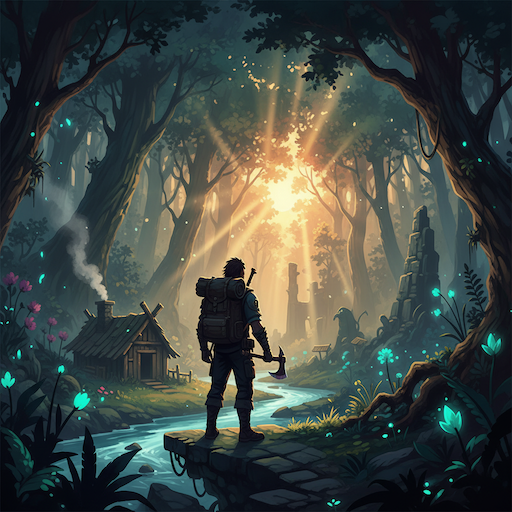
Forest Life is an immersive survival and life-simulation game set in a vast, living forest ecosystem where every decision shapes the player’s journey.
Players begin with nothing but basic tools and must learn to survive by gathering resources, crafting equipment, building shelter, and adapting to dynamic environmental conditions. The forest is not just a backdrop—it is a reactive system filled with wildlife, hidden dangers, and evolving opportunities.
The core gameplay blends exploration, survival mechanics, and storytelling. Players can hunt, farm, fish, and interact with nature while uncovering mysterious elements hidden deep within the forest. A day-night cycle and changing weather conditions directly impact gameplay, forcing players to plan strategically.
The game also features a scenario and progression system, allowing players to create their own stories or follow emergent narratives shaped by their actions. With integrated AI tools, players can generate events, dialogues, and quests, making each playthrough unique.
Key features include:
Open-world forest environment with dynamic ecosystems
Crafting, building, and resource management systems
AI-assisted story and scenario creation tools
Voice or text-based input for scenario generation
Visual customization with user-uploaded or AI-generated assets
Save, resume, and export scenario functionality
Interactive NPCs and evolving storylines
Forest Life is designed to offer both structured gameplay and creative freedom, empowering players not only to survive—but to tell their own story within the forest.
AI-developed sections below
Here's an expanded design brief for "Forest Life," tailored for a small team:
---
Forest Life offers a truly personal survival experience within a dynamic, living ecosystem. Unlike other survival games, your journey isn't just about enduring nature; it's about **actively shaping your own unique story through an innovative AI-assisted narrative system.** Players begin with nothing and must master the wilderness, but their ultimate goal is to craft not just tools and shelter, but the very events and quests that define their adventure, making every playthrough a distinct, player-authored narrative within a reactive, beautiful forest.
Players will engage in a tight, iterative loop of **Survive, Explore, Build, and Narrate.**
1. **Survive:** The immediate need. Players contend with hunger, thirst, temperature (day/night, weather), and health. This involves:
* **Gathering:** Foraging for berries, collecting rainwater, chopping wood, mining stone.
* **Hunting/Fishing:** Tracking wildlife, setting traps, using basic fishing rods.
* **Basic Crafting:** Turning raw resources into essential items like axes, torches, bandages, and basic food.
* **Shelter:** Finding natural cover or erecting simple lean-tos to mitigate environmental threats.
2. **Explore:** Venture deeper into the procedurally generated or handcrafted forest segments to find new resources, discover points of interest, encounter wildlife, and uncover "mysterious elements" (e.g., ancient ruins, strange flora, unique animal behaviors). Exploration ties directly into resource discovery and narrative triggers.
3. **Build & Progress:** As players gather more advanced resources, they can:
* **Expand Shelter:** From basic lean-tos to multi-room cabins with crafting stations (workbench, furnace, farm plots).
* **Advanced Crafting:** Create better tools, weapons, clothing, and specialized items (e.g., water purifiers, storage chests).
* **Sustainable Systems:** Establish farms, advanced fishing setups, and resource processing stations to reduce the grind and focus on exploration/story.
4. **Narrate & Engage:** This is the unique layer. As players survive and explore, they can periodically interact with the AI story tools.
* **Prompting:** Using text or voice input to "ask" the forest for a challenge, suggest a character, or describe a desired event (e.g., "I need a quest about a lost traveler," "Generate a reason for this cave to be dangerous").
* **Emergent Events:** The AI (within game system constraints) generates an event, dialogue with an NPC, or a multi-step quest that integrates with the player's current environment and progress.
* **Interaction:** Players then act on these AI-generated prompts, which might lead to new resource needs, combat encounters, moral dilemmas, or discoveries. These actions feed back into the AI to influence future narratives.
This loop ensures a constant push-pull between immediate survival needs and the desire to uncover or create a deeper narrative, with the dynamic environment and AI acting as co-authors.
**Short-term Progression (Hours):**
* **Skill Trees:** Basic survival skills (e.g., "Foraging Efficiency," "Crafting Speed," "Hunting Prowess") improve through use, unlocking new recipes or efficiencies.
* **Gear Tiers:** Moving from stone tools to iron, then potentially advanced materials, improving durability and effectiveness.
* **Base Expansion:** From a campfire and lean-to to a fortified cabin with dedicated crafting stations, storage, and growing plots.
**Mid-term Progression (Days/Weeks):**
* **Territory Control:** Establishing multiple outposts or safe zones across the forest, making deeper exploration less risky.
* **NPC Relationships:** Developing relationships (trust, animosity) with emergent NPCs generated by the AI, leading to unique questlines and trading opportunities.
* **Biome Mastery:** Unlocking access to and establishing presence in more dangerous or resource-rich biomes within the forest.
* **AI Story Mastery:** Learning how to effectively prompt the AI to generate desired narrative experiences, and understanding its limitations and strengths.
**Long-term Progression / Metagame (Weeks/Months):**
* **Scenario Creation & Sharing:** Players can save their entire game state, including their generated story and base, as a "scenario." These scenarios can then be shared with the community.
* **Visual Customization:** Unlocking and applying cosmetic items for their character and base (e.g., unique building materials, furniture, clothing dyes). This could include user-uploaded or AI-generated visual assets for a high degree of personalization.
* **Lore Building:** Through repeated playthroughs and AI interactions, players collectively build a personal understanding of the "mysterious elements" of the forest, creating their own lore.
* **Challenge Runs:** Engaging with community-created scenarios that offer specific challenges or narrative goals, testing their survival and storytelling skills.
Monetization hooks (fit for the genre)
For a small team, a clear monetization strategy is key:
1. **Premium Base Game:** A one-time purchase for the core experience. This is the primary revenue driver.
2. **Cosmetic DLC Packs:**
* **Character Customization:** Unique outfits, hairstyles, tattoos, or facial paints.
* **Base Customization:** Themed building sets (e.g., "Rustic Stone Pack," "Elven Wood Kit"), decorative furniture, unique lighting options.
* **Tool/Weapon Skins:** Visual reskins for axes, knives, bows, etc.
3. **Expansion Packs (DLCs):**
* **New Biomes:** Introducing new areas of the forest with unique flora, fauna, resources, and environmental challenges (e.g., "Misty Swamps," "Volcanic Peaks").
* **Advanced Crafting Tiers:** Unlocking entirely new tech trees and complex recipes (e.g., "Alchemy Lab," "Advanced Engineering").
* **AI Story Enhancements:** New AI models, expanded prompt parameters, or specialized AI story archetypes (e.g., "Mystery AI," "Survival Horror AI") that offer more sophisticated or specific narrative generation capabilities.
4. **Supporter Packs:** Bundles of cosmetics, unique titles, and perhaps early access to new AI features or minor content updates to reward dedicated players.
1. **AI Quality & Coherence:** The biggest risk. Ensuring AI-generated events, dialogues, and quests are consistently coherent, engaging, and make sense within the game's established rules and tone. Preventing nonsensical or repetitive outputs is critical.
2. **AI Integration with Gameplay:** How seamlessly do AI-generated narratives interact with core survival mechanics (e.g., if AI creates a quest requiring a specific rare item, is that item actually obtainable and balanced within the crafting system)?
3. **Performance & Scope:** An "open-world forest with dynamic ecosystems" can be incredibly demanding for a small team to build, optimize, and fill with content (even with AI assistance, core assets are needed).
4. **Player Onboarding:** Managing player expectations for AI-driven storytelling and teaching them how to effectively use the scenario generation tools without feeling overwhelmed or underwhelmed.
5. **Moderation of User-Generated Content:** If user-uploaded assets or shared scenarios become a feature, a robust moderation system will be necessary to prevent inappropriate content.
6. **Cost of AI Models:** If relying on external AI APIs, the operational costs could be significant, especially with high player engagement. A local, smaller-scale model might be necessary.
1. **AI Model Choice & Implementation:** Will we use a local, fine-tuned LLM, or integrate with an external API (e.g., OpenAI, Google Gemini)? How will we manage the cost and latency? What are the specific guardrails to ensure appropriate and coherent content?
2. **Scope of "Dynamic Ecosystems":** How deep will the simulation go? Will animal populations genuinely react to player hunting? Will plant life grow and deplete? What level of detail is achievable for a small team?
3. **"Mysterious Elements" Specifics:** What kind of overarching lore or "mystery" underpins the forest? Is it supernatural, sci-fi, or purely naturalistic? This will guide the tone of AI-generated stories.
4. **Player Control over AI:** How much control does the player have over the *parameters* of AI generation? Is it just free-form text input, or are there sliders/options for genre, difficulty, character archetypes, etc.?
5. **Technical Foundation:** What game engine will be used (Unity/Unreal)? This significantly impacts development time, asset pipeline, and performance capabilities.
6. **Art Style:** What specific art style (e.g., realistic, stylized, low-poly) will be chosen? This is crucial for managing asset creation for a small team and defining the game's identity.
7. **Multiplayer:** Is there any plan for cooperative survival or shared scenario experiences? If so, how does the AI story generation handle multiple players?
8. **"Victory Conditions" for Scenarios:** For player-created or AI-generated scenarios, will there be explicit "win" or "lose" states, or is it purely open-ended survival and storytelling?
9. **Basic Tool & Resource Variety:** What is the initial set of tools and what is the minimum viable set of resources needed to provide depth without overwhelming complexity?